RECIPE

Venetian Pasta with Duck Ragu Recipe – author Daniel Bellino


BIGOLI with DUCK RAGU all VENENZIANA


BIGOLI in SALSA
BIGOLI with DUCK RAGU


PASTA with DUCK RAGU


Duck ragu with bigoli is a traditional dish here in Veneto where I live. In fact, if you visit the region you are bound to find it in many restaurants. It is also often cooked by the Venetians on holidays or feast days.

Bigoli looks like a very thick spaghetti and is often eaten with various fat-rich sauces; the most well-known bigoli recipe is with duck ragu. In the past, the traditional recipe for this dish involved cooking the pasta in a fatty broth in which a young duck had been boiled. 

The Venetians then made a sauce with flavored butter and the offal of the duck, which they ate with the bigoli. The duck itself was eaten after.


DUCK RAGU Recipe :

Ingredients :

1 whole Duck

5 Tablespoons Olive Oil, and 1 tablespoons Butter

1 Carrot & 2 Clery Stalks, and 1 small Onion

2 Bay Leaves and I bunch fresh Sage

3 tablespoons Tomato Paste, and 1 cup Tomato Pasta (puree)

3/4 teaspoon Salt, and 3/4 teaspoon ground Black Pepper

3/4 cup dry Red Wine

1 pound fresh Bigoli Pasta, or Spaghetti or Bucatini 


Cut the Duck into 4 pieces, and place on a large baking pan. Season with a little salt and black Pepper. Place in a 350 degree oven and roast for 16 minutes.

Take the Duck out of the oven and pour off excess fat that has rendered out of the duck. You can save the fate to use for roasting potatoes at another time.

Place the duck back in the oven to cook more.

Place the olive oil, carrots, onions, and Celery in a large pot and cook on medium heat for 4 minutes. Sprinkle on a little Salt and Black Pepper, and continue cooking on low heat for 7 minutes.

Add the Tomato Paste to pot and cook on high heat for 4 minutes. Add the wine, and cook on high heat for 7 minutes, until the wine half reduced by half its original volume.

Add the tomato paste and sage and cook on medium heat until the tomatoes start to bubble.

Remove the Duck from the oven after it has cooked for a total of 30 to 35 minutes. Drain the fat off the Duck.

Place the Duck pieces in the pot with the Tomatoes. Cook on low heat for about 1 and 15 minutes. Make you stir the bottom of the pot from time to time with a wooden spoon, to keep the sauce from burning on the bottom.

Remove the Duck from the pot and let it cool for about 15 minutes. Also remove the burn of Sage and Bay Leaves from the pot and discard.

Once the Duck has cooled, remove the meat from the bones. Place the duck meat back into the sauce pot and cook on a very low flame for 20 minutes.

Cook your pasta of choice as the duck is simmering.

Take a half cup of pasta water from the pot and set aside. When the pasta is finished cooking, drain the pasta in a colander. Place the pasta back in the pot it cooked in, add about 2 cups of the Duck Ragu to the pot, with a knob of butter and 1 tablespoon of olive oil and mix. 

Divide the pasta among 4 to 6 plates, in equal portions. Add about 3 tablespoons of the Duck Ragu on top of each portion of pasta and serve.

Serve with grated Prmigiano Reggiano or Grana Padano Cheese on the side.

Enjoy !


RECIPE by Daniel Bellino Zwicke

SUNDAY SAUCE

AMERICA’S FAVORITE ITALIAN COOKBOOK

Daniel Bellino Zwicke


GOING to ITALY ?
HOTELS – EUROPE

And WORLDWIDE

Official Ragu Bolognese Recipe of Bologna Italy

.
.
.

This is The OFFICAL RECIPE for BOLOGNESE RAGU of BOLOGNA, ITALY

This RECIPE CRITERIA for a Properly Made “RAGU” (of Bologna) according to 

AGRICOLTURA Di BOLOGNA (The Agricultural Commission of BOLOGNA)

This is the renewed recipe for the real ragù alla bolognese:
 
 
INGREDIENTS AND DOSES (FOR 6 PEOPLE)
 
Coarsely ground beef: 400 g; Fresh sliced ​​pork belly, 150 g; half an onion, about 60 g; 1 carrot, about 60 g; 1 stick of celery, about 60 g; 1 glass of red or white wine; Tomato puree: 200 g; Double concentrated tomato paste: 1 tablespoon; 1 glass of whole milk (optional); Light meat or vegetable broth (also stock cube); Extra virgin olive oil: 3 tablespoons; Salt and pepper.
 
 
PROCEDURE
 
In a non-stick saucepan (of excellent quality, heavy) or made of aluminum or enameled cast iron (once upon a time the earthenware pot was very popular) of 24-26 cm in diameter, melt the minced or chopped bacon with 3 tablespoons of oil. Then, add the finely chopped herbs on the cutting board (do not use the mixer) and slowly fry the mixture over medium-low heat, always stirring with a wooden spoon (the onion must absolutely not take on a burnt flavor). Raise the heat and add the minced meat and, always stirring carefully, cook it for about ten minutes until it “sizzles”.
Pour the wine and let it evaporate and reduce completely, until you no longer smell the wine and then add the concentrate and the puree. Continuing to mix well, pour a cup of boiling broth (but you can also use just water) and cook slowly, with the container covered, for about 2 hours (even 3 hours depending on your preferences and the meats used) adding the hot broth as needed. Halfway through cooking, according to an advisable ancient tradition, you can add the milk that must be reduced completely. Finally, once cooking is finished, season with salt and pepper. The ragù should be a nice dark orange color, enveloping and creamy.
 
NOTE :
Traditionally in Bologna they used the “cartella”, that is the diaphragm of the beef, today difficult to find. In its absence, or in addition, the front cuts rich in collagen are to be preferred such as the muscle, the shoulder, the under-shoulder, the belly, the brisket. Mixed cuts can be made. According to a modern processing technique, the meats are browned well separately, alone, and then mixed with the chopped herbs, also already browned.
 
 
VARIANTS ALLOWED :
1) Mixed meats: beef (about 60%) and pork (about 40%) (loin or neck);
2) Minced meat;
3) Rolled or flat pork belly instead of fresh bacon;
4) A scent of nutmeg;
VARIANTS NOT ALLOWED
 1) Veal pulp;
2) Smoked bacon;
3) Only pork;
4) Garlic, rosemary, parsley, other herbs or spices;
5) Brandy (in place of wine);
6) Flour (to thicken).
BOLOGNESE RAGOUT CAN Be ENRICHED With :
 1) Chicken livers, hearts and gizzards;
2) Peeled and crumbled pork sausage;
3) Blanched peas added at the end of cooking;
4) Soaked dried porcini mushrooms.
.
.
.
.
The RAGU BOLOGNESE COOKBOOK
AMERICA’S FAVORITE RECIPE
.
.
.
.
TAGLIATELLE BOLOGNESE
.
.
“Over the years, the recipe registered in 1982 has been reported in books, magazines, newspaper articles and websites in Italy and the rest of the world, constituting a clear and reliable point of reference; however, after four decades, a study of the changes that have occurred in the creation of this symbolic dish of Italian cuisine, loved throughout the world, was required.
There have been improvements in ingredients, in the quality of containers and in heat sources, as well as changes in eating habits which have had partial effects on the way ragù is prepared.
The three Bolognese Delegations have therefore set up a “Study Committee” for the updating and improvement of the recipe for Ragù alla Bolognese and, in order to obtain a current and complete overview, the Committee has consulted, through a specific questionnaire: the best restaurants in the city, custodians of tried and tested recipes; families with ancient traditions; expert gastronomes.
Ragù alla Bolognese, like all long-standing recipes, is made in families and restaurants in ever-changing ways, as demonstrated by the fact that the recipes received during the study are all different from each other, often in small details but, at times, also with substantial differences.
The “Study Committee”, making a reasoned synthesis, has therefore drawn up a new version of Ragù alla Bolognese which is very detailed in the procedure, with variations (allowed and not allowed) and advice on the cuts of meat and on possible “enrichments”.
The three Bolognese Delegations of the Italian Academy of Cuisine have thus decreed which recipe currently adheres most closely to the formula that guarantees the classic and traditional taste of the true Ragù alla Bolognese, which is what is made, cooked, served and enjoyed today in homes, in restaurants and in bars.
trattorias and restaurants in learned and fat Bologna.
The registered recipe is not intended to be the only possible one, but rather to be a safe guide to the creation of an excellent dish that does not betray traditional customs and establishes some fixed points, with the awareness that, as with musical scores, the true art lies in the execution”.
The notarial deed of the recipe is now jealously guarded in the Palazzo della Mercanzia. It completes the collection of thirty-four recipes of the Bolognese gastronomic culture deposited. All the result of the collaboration between the Chamber of Commerce of Bologna and the Italian Academy of Cuisine that began on April 16, 1972 with the deposit of the golden measure of the authentic Ta
gliatella alla Bolognese.

When Nonna Makes Sauce – Sunday Sauce Gravy Recipe


NONNA GINA PETITTI

NONNA Makes SAUCE

NONNA GINA Makes SUNDAY SAUCE

Recipe – Nonna Gina

MEATBALLS :

2 lbs. Ground Beef
2 Extra Large Eggs
1/2 cup chopped Fresh Parsley
1 teaspoon Salt
1/4 teaspoon powdered Garlic
1/2 cup grated Pecorino Cheese
1/2 teaspoon Black Pepper
1/2 cup Bread Crumbs

Sauce/Gravy:
3 quarts Tomato Puree
1/4 cup Fresh Basil
1/4 cup Fresh Parsley (optional)
Olive Oil
1/2 cup sliced Onion
2 cloves Garlic
4-6 Pork Neck Bones
4-6 Pork Ribs
6 Sweet Italian Pork Sausage
Meatballs (from above)
Salt & Pepper to taste
NONNA GINA PETITTI
Gina Petitti was born in 1935 in Faeto, Italy. Her family ran a farm in Italy and she met her husband, Vito, in the same town. In 1970 Gina, Vito, and her 4 children immigrated to America. Gina’s husband passed away in 2012, but she is surrounded by a large family, which includes 9 grandchildren, and lives 5 minutes away from her eldest daughter in New Jersey. Gina spends her time cooking, gardening, and being an active member of her local Church.


Some More GREAT SAUCE !!!


SUNDAY SAUCE

alla BELLINO alla PACINO

CLEMENZA’S GODFATHER SAUCE

JOE DiMAGGIO’S Mom’s GRAVY

MEATBALLS – BRACIOLE

And MUCH MORE

AMERICA’S FAVORITE ITALIAN COOKBOOK

SUNDAY SAUCE by DANIEL BELLINO


Pizza Night 1960s and 70s America – New Jersey


Screen Shot 2017-11-29 at 4.26.43 PM
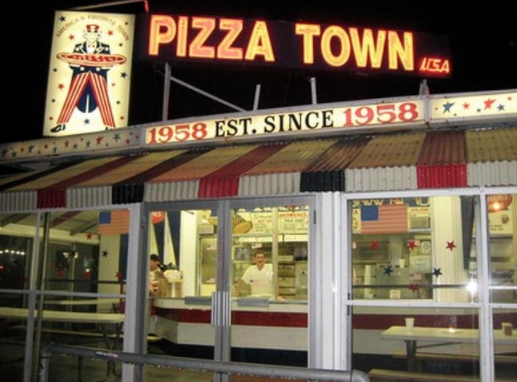
Pizza Town
Route 46 , Garfield , New Jersey

“The First Place I ever had a Calzone!”


   My first memories of PIZZA were from Bella Pizza in East Rutherford, New Jersey. I was a young boy and this Pizzeria just opened on Park Avenue. It was a standard Pizzeria like many others found all over the New York-New Jersey metro area, serving solid pizza just the way the locals like it. The pizza was of a high standard as all the pizza must be if you’re going to make and sell Pizza in the heavily Italian-Populated New York and New Jersey areas. A large pie which you just ordered as a Pie, the one that is known as Pizza Margherita in Italy is made of the pizza dough topped with tomato sauce, Mozzarella Cheese, salt, pepper, and a little olive oil. Basta! 
The Pizza in America are much larger than those made in Italy and are cut into 8 triangular slices and are enough for 2 or 3 people to eat, or even four if you’re not that hungry or sharing a Pizza just as a snack in-between meals. I can still remember the price of the pizza at Bella Pizza in East Rutherford back in the 60s a whole pie cost just $1.50 and a slice was .20 cents. So if you wanted what they call in Napoli and all over Italy the Pizza Margherita, you just simply ordered a Pizza, or a Cheese Pie, or simply a Pie, meaning it was with Tomato, Mozzarella , and Basil and no other toppings. And if you wanted extra toppings, you just say a Pepperoni Pie, or half mushroom half pepperoni, or a Sausage Pie or whatever. That’s the way it was and more or less still is with ordering Pizza at your standard pizzeria. Nowadays most pizza cost between $2.25 and $2.75 a slice and about $16.00 to $20 and even more for a whole plain pie.


Anyway, as most kids did and do, we loved eating pizza, and on most Friday nights it was Pizza Night for many families in Jersey. Mom didn’t want to cook that night, the kids loved getting pizza and looked forward to it as a special treat on Friday nights, as we knew it as Pizza Night and we just loved it. We’d have pizza, Coca-Cola and some sort of sweets, a cake or Ice Cream for desserts after we ate our Pizza. Yes Friday Night Pizza was always a much-loved treat as a child growing up in Jersey in the 1960s and 70s. We’d listen to WABC Radio and Top 20 Hits, R&B, and Rock-N-Roll and all was fine in the World, we had all that we needed. How I miss those sweet days of youth and a simpler time than today. Back then you had everything you needed in life. We had Radio and TV and we still do today. We had Cars that were beautiful unlike some of the ugly ones of today. We had the Telephone, no cel phones or internet, we didn’t need them. We all had a Football, a Basketball, a Baseball Bat, Baseball, and Glove to play Baseball, Basketball, and Football as all healthy American boys did back then. 

Growing up in the 60s and 70s, we didn’t have Video Games but we had Aurora Racing Car sets, maybe Electric Trains, and wonderful Board Games like; Monopoly, Candyland, Chess, Checkers, Stratego, and Battle Ship. And one of the most wonderful things we had back then in the 60s & 70s was great music unlike the Crap they call music today, we had Great Top 100 Hits, wonderful R&B sounds of Motown and The Philly Sound, The Beatles, The Rolling Stones, and Rock-N-Roll, what do the kids have for music today? Sadly, just Crap Rap and the other garbage they think is music. Yes it’s quite sad what has happened to music in the past 20 years. But yes, we had everything we needed; Radio, TV, cars, a stereo, Sports, great music to listen to, and Pizza, we always had Pizza, we still do.


Well sorry, I got off topic, but it’s all part of the story you see. In Italy when it comes to Pizza it’s a bit different than the way Pizza is done in America. Pizza was born in Napoli where it is revered into a high religion and is to be made just so. The Pizza is much smaller and is made for one and they do not make slices unless you are in Rome or other parts of Italy where they make Pizza that is made in large pans ahead of time and then cut into squares and heated up when a customer orders some. That’s Pizza Taglio, and most Pizza made in Italy is Neapolitan Pizza that is made to order. As we’ve said they are individual sized (about 12” round) for one person and made to order and are cooked in hot wood burning ovens to strict standardized specifications. A Pizza Margherita made in the true Neapolitan fashion is made with fresh tomato puree, olive oil, salt, fresh garlic, basil, and mozzarella placed on top, then the pizza cooks in the hot wood burning oven, and is ready in just about 4-5 minutes. Pizza Margherita was created by Raffaella Esposito in 1889 where he was working at Pizzeria di Pietro. He made the Pizza and named it in honor of Queen Margherita of Savoy who was visiting Naples (Napoli) at the time. 

American Pizza is made with a cooked sauce and we tend to put more sauce and cheese than they do in Italy .

 Now, my own experience eating Pizza in Italy. Well the first pizza I first had in Italy was Pizza Taglio (pan Pizza) and not the Classic Neapolitan Pizza, which is by far the dominant pizza in all Italy, and though there is Pizza Taglio which is sold in square slices, it’s a mere fraction as far as its presence goes, which is probably just 10% of all Pizza consumed in Italy is Pizza Taglio, the rest being classic Neapolitan. Anyway, there’s very good pizzeria that makes Pan Pizza close to the train station in Rome. Like other pizzerias that make Pizza Taglio in Italy, there’s an array of different pizzas with different toppings that are already made and are laid out before you. You choose which type of pizza you’d like, tell them the size you want, they cut it and weight it to determine the price by weigh.

Yes the pizza is a bit different in America, but it’s dammed good, and America makes the world’s best pizza outside of Italy. And as far as Pizza goes in America, everyone knows that the best Pizza in the country is made in New York, and especially in Brooklyn with great shrines to Pizza in the form of : Tottono’s in Coney Island, Grimaldi’s, and DiFara Pizza by Pizza Maestro Dom DeMarco. Then you’ve got John’s on Bleecker Street in Greenwich Village and the first Pizzeria ever to exist in the United States Lombardi’s on Prince Street, established in 1905. 


Anyway, enough with the technicalities of Pizza, sometimes things are analyzed too much, just eat it and enjoy. We loved eating Pizza on Pizza Night or any time of the week when we were lucky enough to get it. And there is one particular time that I always remember. We went on a trip with our local church to the big beautiful Riverside Cathedral in New York one time, and it was a very special trip. When we came home that night, the Priest and other church officials threw a little Pizza Party for us in the church basement. They ordered a bunch of Pizzas for all the kids (Grownups too) and it was a very special thing for us, as pizza always was and even so to this day. Yes there’s nothing like when you’re a child and they have a Pizza Party for you, we just loved it. And so these are my memories of Pizza.


Excerpted From “MANGIA ITALIANO” Memories of Italian Food  


     by Daniel Bellino-Zwicke


Screen Shot 2017-11-29 at 4.30.42 PM.png
Typical Large Pie for PIZZA NIGHT in The 60s


Read about PIZZA NIGHT , CANNOLIS, PROVOLONE, MEATBALLS, 
Growing Up Italian in America, Italian Food, Italy, and more, 
in best selling author Daniel Bellino-Zwicke’s 
latest book, Mangia Italiano – Memories of Italian Food.


Screen Shot 2016-08-22 at 11.04.43 AM.png
MANGIA ITALIANO !

The Latest From Daniel Bellino “Z”


PIZZA DOUGH RECIPE

POSITANO The AMALFI COAST

TRAVEL GUIDE – COOKBOOK

100 REGIONAL RECIPES – NAPLES

Including – PIZZA DOUGH PIZZA Recipe
POSITANO CAPRI NAPLES SORRENTO


.